

One weak tackle can ruin your entire passing concept. A slow linebacker leaves the middle wide open. And that expensive receiver you spent everything on? Barely matters if your quarterback has no time to throw. Building a competitive Madden NFL 27 Ultimate Team on a budget is less about chasing the biggest names and more about fixing the specific problems that keep costing you possessions.
The challenge is that every card you want is competing for the same coin balance. Some players look for ways to buy mut coins to get ahead faster, but a bigger balance alone cannot replace a clear roster plan. The smarter move: diagnose your lineup first, build a routine that earns resources consistently, learn how the Auction House actually works, and then spend on players whose abilities fit the football you actually play

1. Audit your lineup before you spend a single coin
Pull up your last three to five games and write down why drives ended and how your opponent created their biggest plays. “My defense is bad” is not useful information. “My user-controlled linebacker arrived late on two crossing routes” is something you can actually fix.
Sort each failure into one of three categories:
- Personnel: The player was in the right place but lacked the speed, blocking, coverage, or catching ability to finish the play.
- Execution: The card was capable, but a late read, poor stick input, or mistimed adjustment caused the breakdown.
- Scheme: The play call created a bad matchup regardless of the player’s rating.
Only the first category actually points to the Auction House. The other two can be solved in Practice Mode, by switching playbooks, or by making smarter pre-snap adjustments. Knowing the difference protects your coins from becoming an expensive substitute for learning.
Before buying any replacement, recreate the same situation in Practice Mode against the coverage or pressure that caused the problem. If a protection adjustment or a better read fixes it, keep the player. Save your coins for a weakness that execution genuinely cannot correct.
One more thing worth checking: your depth and specialist packages. Madden NFL 27 rewards Team Chemistry, and some player combinations produce meaningful boosts. The “Generate Best Lineup” option can surface cards you have overlooked, but treat it as an audit tool, not a final decision. An automatic lineup cannot know which concepts you call most often.
2. Build a repeatable coin-earning routine
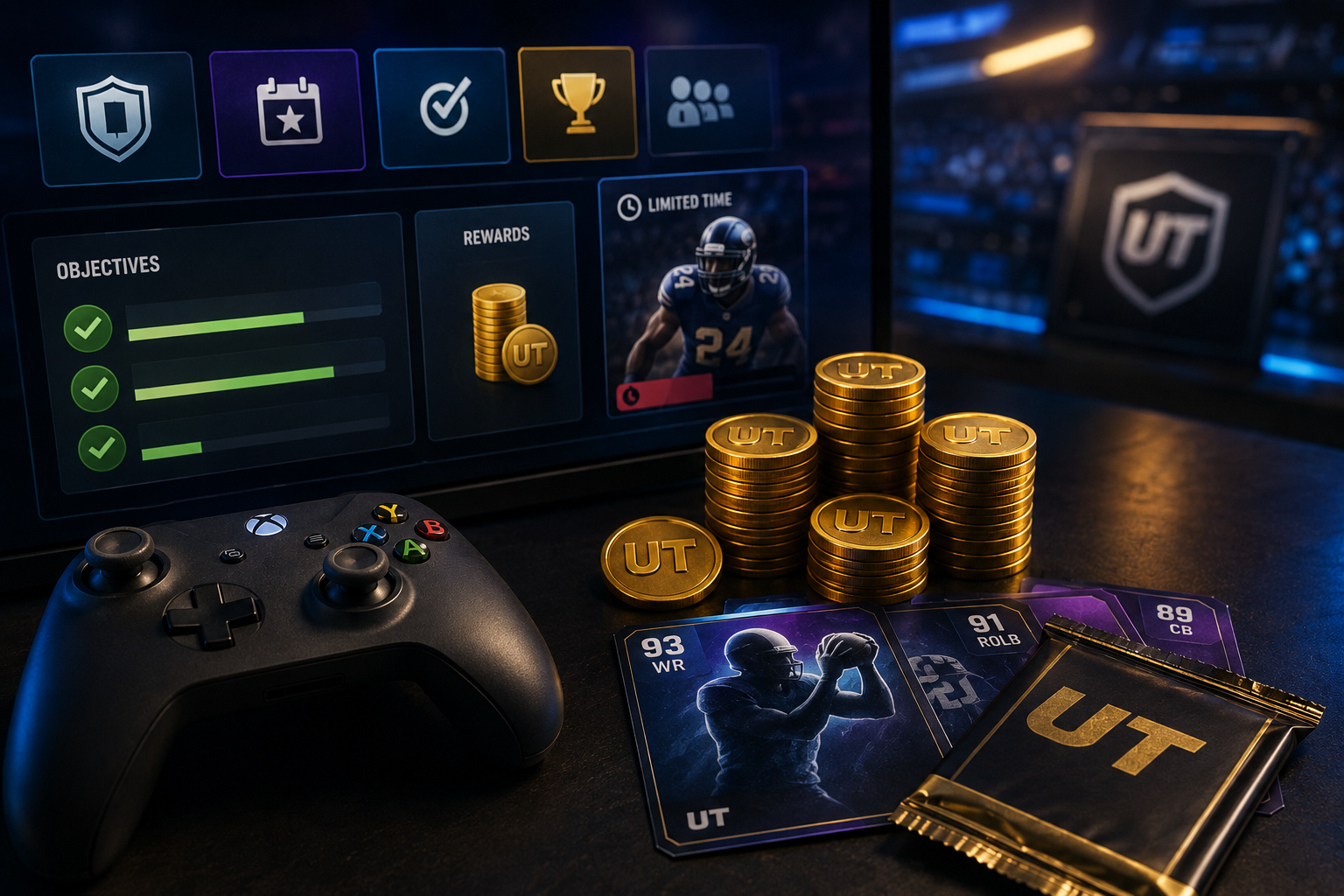
Random play produces random progress. A simple routine builds resources steadily without turning MUT into a second job.
EA’s legitimate earning methods include Solo Challenges, Events, Objectives, Solo Seasons, and competitive modes. The key is picking activities that match your time, your skill level, and your appetite for online play, then sticking to them.
Start each session by checking active objectives and limited-time events, and look for overlap. If one objective rewards passing yards and another gives bonuses for wins with a specific lineup, combine them into the same session. New players can build through Solo Challenges; more experienced players might prefer performance-based modes where the rewards scale with results.
After each session, review your rewards before discarding anything. Check whether a duplicate item improves Chemistry, fits a useful Set, or can be sold. Compare the market value of auctionable items against their quick-sell return. Then track your time played versus coins earned. After a week, drop the activities that feel inefficient and double down on what’s working.
3. Make upgrades that actually change the outcome of games
Once you know your real weaknesses, rank upgrades by how often they affect a snap. A modest improvement at a heavily used position will almost always outperform a star card who touches the ball twice per game.
Protect your core offensive concepts first
Build around the plays you trust on important downs. If you run a pass-heavy offense, find out which blocker is giving up pressure before your routes develop. If you prefer to run the ball, prioritize the linemen responsible for your preferred gaps. Do not pay for a famous player whose strengths belong to a different scheme than the one you actually run.
Remove the defender your opponents keep targeting
Most defenses have one assignment that good opponents attack repeatedly. It might be a corner who cannot hold up in man coverage, a safety who arrives late over the top, or a linebacker who struggles in open space. Upgrade that role before adding luxury depth anywhere else. Removing an obvious target also opens up your play-calling because you stop having to hide that weakness every down.
Compare abilities and Chemistry, not just overall rating
Overall rating is a summary, not a job description. What matters is the specific attributes and abilities that affect what the player actually does on a given snap. Also check whether a replacement strengthens or breaks an active Chemistry threshold. A slightly lower-rated card that fits your roster can contribute more than a higher-rated card that weakens the connections around it.
Upgrade depth only where it reaches the field
Backups matter when they enter specialist packages, rotate in because of fatigue, or contribute on special teams. They matter very little when they never see the field. Review your actual formations before spending on depth, then direct coins toward the reserve positions that receive genuine snaps. This keeps the roster balanced without paying for ratings that just sit on the menu screen.
4. Treat the Auction House like a market, not a slot machine
Before placing any bid, compare several listings for the same card or its alternatives. Note the going rate and set your maximum price before bidding, not while you are in the middle of losing an auction. One high listing does not mean the market has moved. Recheck before raising your limit.
Always include EA’s 10 percent transaction fee in any resale calculation. A card bought for 40,000 coins and sold for 42,000 actually produces a loss after the fee. It needs to sell for more than roughly 44,445 coins just to break even. Leave room for price shifts rather than treating every discount as guaranteed profit.
Keep a portion of your balance available for the next upgrade or a genuine bargain. Supply changes constantly as new rewards enter the market, so flexibility has real value. Treat packs as entertainment with uncertain returns, not a reliable investment strategy.
On the topic of third-party coin sellers: EA’s rules explicitly prohibit buying coins from outside sources, and violations can result in account action. The legitimate ways to earn are playing MUT, completing Solo Challenges, and selling items fairly through the Auction House. Never share your account credentials, and don’t assume any seller’s claims override the game’s own rules.
The bottom line
A good MUT budget has a purpose for every coin. Diagnose losses before shopping. Build a session routine and stick to it. Preserve valuable rewards before discarding. Choose upgrades that support your actual scheme and Chemistry. Use a written price ceiling in the Auction House and always account for the transaction fee.
Most importantly, test one change at a time. Play several games after each upgrade and look specifically for the situation it was meant to fix. If the problem disappears, the purchase worked. If it remains, reconsider the scheme or execution before spending again. That habit turns roster building from a chase for bigger numbers into a practical process that produces a team performing better where it matters most: on the field.