

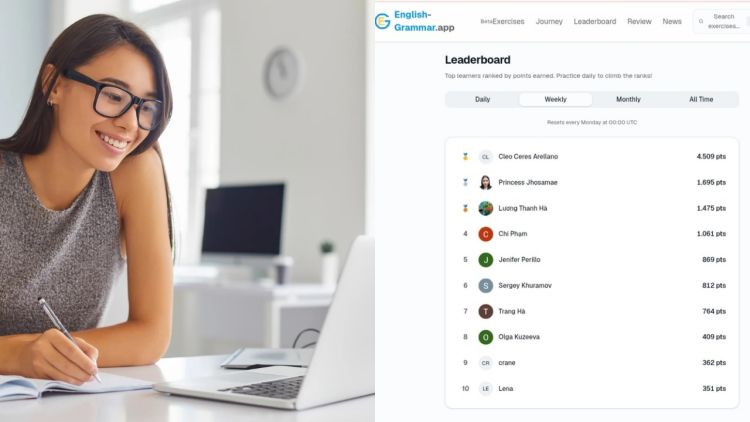
Conditionals look neat in charts and messy in real sentences. Learners often memorize zero, first, second, and third conditionals as four distinct stickers, then freeze when a prompt mixes a past cause with a present result. I stress-tested that failure with a “dirty battery” of if-clause items—starting with clean type drills, then deliberately crossing time frames—using focused conditionals exercises instead of mindlessly browsing another general grammar homepage.
The point of the battery was not to collect badges. It was to see whether a structured conditional map could force the only decision that actually matters: which clause is past, which clause is present, and which verb pattern follows. Labels only help after that judgment is made. They fail completely when they replace it.
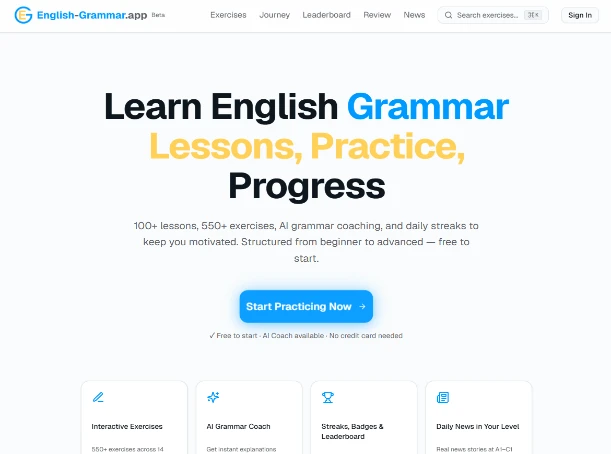
Build a “Dirty Battery” Before Opening Any Grammar Chart

Practice first, memorize later-canva via canva%20com
Start with three item types on paper or in a notes app. Item A is clean: a general truth that requires present + present. Item B is a real future plan that requires present + will. Item C is a regret about yesterday that requires past perfect + would have. Write your answers cold. Do not peek at formula charts yet.
Then, add two hostile variants. Item D keeps the same vocabulary as C but moves the result into now (“…I would be fluent today”). Item E keeps a present personality trait in the if-clause and asks for a past consequence. Those two are where sticker memory collapses. If your clean items are fine but D and E feel like a coin flip, you do not need another overview page. You need comparison practice that punishes time-frame blindness.
| Battery Item | Pressure Applied | Pass Signal |
|---|---|---|
| A, B, C: Clean zero / first / third | Form recall | Stable structure under no time mix |
| D: Past cause → present result | Mixed Type 3→2 | You name both times before conjugating |
| E: Present state → past result | Mixed Type 2→3 | You refuse a pure third conditional when “now” sits in the if-clause |
Use this table as a gate. Only after D and E fail should you open a full conditional library. Otherwise, you will congratulate yourself on clean drills and still miss mixed items on your exams.
Map Your Conditional Practice Before You Drill Randomly
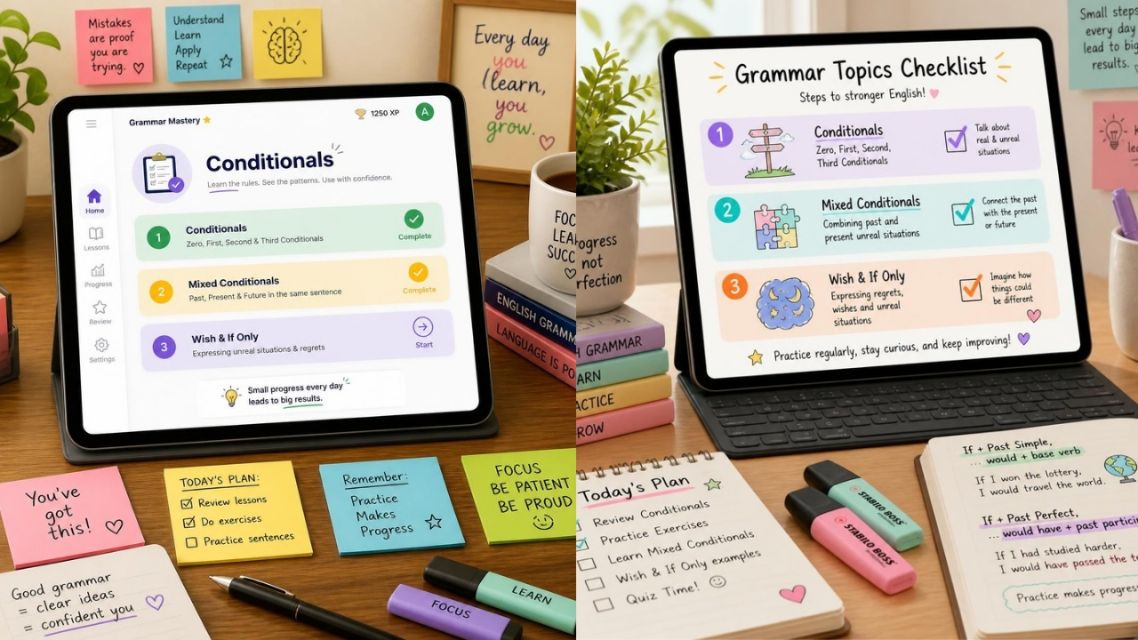
A structured study plan makes grammar easier to master-canva
The English Grammar App groups this work under “Conditionals & Subjunctive” with a shelf specific enough to plan an entire week of study: 7 topics, 29 exercise sets, and 580+ questions, plus PDF worksheets. The topic order is practical for a tutorial path—Zero, First, Second, Third, Mixed, Conditional Comparison, then Wish & If Only—instead of dumping every if-clause into one endless quiz.
Each topic page pairs a lesson of structural formulas and common mistakes with interactive sets. Modes stay consistent with the rest of the product: Choice, Worksheet, Typing, and PDF. That matters for the battery. Choice confirms recognition. Typing reveals whether you can produce “would have” without options. PDF lets a teacher run the same decisions on paper.
- Finish one clean set in Zero and one in First while saying the time frame out loud.
- Do Second for unreal present advice (“If I were you…”) without mixing past regrets yet.
- Move to Third only for past-unreal regrets; keep “yesterday” language strict.
- Open Mixed Conditionals only after D/E from your dirty battery still feel shaky.
- Use Conditional Comparison as the exam rehearsal, not as day-one sightseeing.
This order is slower than randomly clicking a “conditionals quiz.” It is also the only order that matches how mistakes actually form. People do not usually lack an understanding of the zero conditional. They lack the discipline to stop and think when time frames diverge.
What Mixed Conditional Sets Are Really Training

Practice mixed conditionals with focused exercises-canva via canva.com
On the Mixed Conditionals lesson path, the site frames two crossings: Type 3→2 (If + past perfect, would + base) for a past cause with a present result, and Type 2→3 (If + past simple/were, would have + past participle) for a present state with a past consequence. That is the language I used to score my dirty items. If I could not label the crossing before answering, I treated the attempt as a failure, even if I guessed the correct form.
Comparison Sets as the Final Grammar Filter

Understanding test with comparison exercises-canva via canva%20com
Conditional Comparison is where your study tutorial should climax. Those sets ask you to choose among zero, first, second, third, and mixed conditionals in context. That is much closer to Cambridge-style exam pressure than finishing five identical second-conditional affirmative sentences. In my testing, I only marked a topic “stable” after passing a comparison set, not after a single-type warm-up.
How to Step Through the Battery Without “Tourism”

Follow a step-by-step grammar study routine-canva via canva.com
Day 1: Dirty battery on paper, then one Zero and one First Choice set.
Day 2: Second and Third in Typing mode for production.
Day 3: Mixed sets only for the crossings you failed.
Day 4: Conditional Comparison in Worksheet mode to simulate scanning a full page.
Day 5: Wish & If Only, but only if your writing still confuses “wish + past perfect” with third conditional regrets.
Keep a one-line log after each day: which crossing failed, which mode exposed it, and whether you used an AI credit. That log is your tutorial artifact. Without it, five busy days of studying still just look like grammar tourism.
The English Grammar App also provides a free floor for trying the machine—Pre-A1/A1 breadth, the first two sets per topic, sample topics by level, and five AI Grammar Coach credits per day. This lets you validate the path before unlocking deeper A2–C1 volume on paid plans. Spend those credits on one recurring miss from Mixed or Comparison sets, not on asking the coach to rewrite the whole chart. The coach sits inside exercises as a Claude-powered explainer; it is a repair tool, not a replacement for deciding time frames yourself.
- Say the time of each clause out loud before you touch the verb.
- Fail D/E on purpose in week one; analyzing that failure is the curriculum.
- Promote Comparison to your “done” test, not single-type scores.
- Use the PDF export feature when a class needs the same items offline.
- Keep Wish practice after Mixed, so regret language does not blur your structures.
Teachers can assign the dirty battery as a five-minute starter, then assign one English grammar exercises set that matches the weakest item type. Students return with the sentence they still cannot justify. That single justification is better homework evidence than a screenshot of 100% on an easy Choice set.
Common Error Patterns the Path is Built to Catch
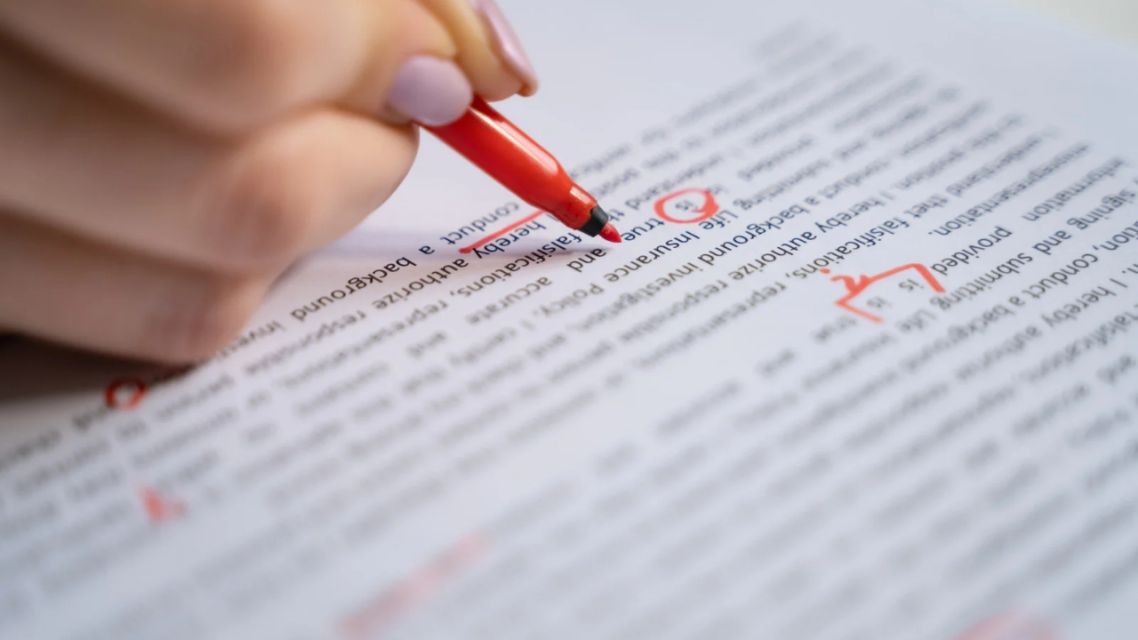
Learn from mistakes to improve grammar accuracy-canva
Watch for three common repeats. First, learners drag will into zero truths. Second, they use would have for a present imaginary scenario. Third, they treat mixed conditionals as an “advanced third” instead of a precise time-cross. When any of these repeat twice, stop advancing topics. Re-run the same mode on the same topic. Real progress is making fewer unjustified guesses, not just reaching a higher topic number on the shelf.
When to Stop the Week Early

- Review difficult topics before learning new ones-canva
Stop early if Comparison sets still feel like luck after two passes. Going into Wish & If Only will only add another regret pattern on top of an unsolved time-cross. Instead, repeat Mixed Conditionals with Typing mode, then do one Comparison Worksheet. Boredom at this stage is diagnostic, not a reason to hop to a new category.
The Verdict for Learners Who Keep Mixing If-Clauses

Practice and consistency are the keys to mastering English conditionals-canva via canva.com
If your conditional errors are random, you need volume. If your errors are confident but wrong on mixed time frames, you need a forced decision path. The English Grammar App fits the second case perfectly: it offers a clear zero-to-wish shelf, mode switching, and comparison sets that punish blind sticker memorization.
Use it if you are willing to follow the order and score your D/E items honestly. Ignore it if you only want conversation partners or essay coaching. For mastering grammar forms under exam pressure, finish the dirty battery first, then let the conditional map do the boring work of making time frames visible before any verbs get chosen.